
Today’s baby boomers and Gen X residents expect more than just care. They want autonomy, purpose, and a lifestyle that adds life to their years, not just years to their life. For them, well-being isn’t a bonus. It’s the baseline. Forward-thinking communities are responding by putting well-being at the heart of their strategy.

Cubigo’s Happy Aging 360 brings all fragmented signals together in a smart and data-driven solution. The Happy Aging 360 multi-dimensional instrument directly measures the impact of personalized well-being and healthy aging plans as a combination of social activities, fitness, nutrition advice, cognitive and mental health support and more. It helps communities understand who is truly thriving, and who may need more support.
As a true platform, Cubigo is uniquely positioned to connect and enrich data across every touchpoint of resident life—from engagement and activities to dining, services, and communication. The end goal is a fully holistic, data-driven understanding of each resident’s well-being, where patterns, correlations, and early signals become visible and actionable. Happy Aging 360 is the first step in that journey. Through a short, intuitive resident survey, it captures essential well-being insights that lay the foundation for this broader, integrated view—gradually evolving into a powerful intelligence layer that enables more proactive and personalized support.
In just 3 minutes, Happy Aging 360 turns even the quietest or unspoken feelings into clear, actionable insights. No more relying on assumptions or observations from team members alone, but real data to help shape a vibrant community life.
This science-backed instrument gives your team a deeper understanding of what truly matters to residents: the place where they live, autonomy, joy, purpose and connection. The insights are instantly available, ready to support daily decisions.
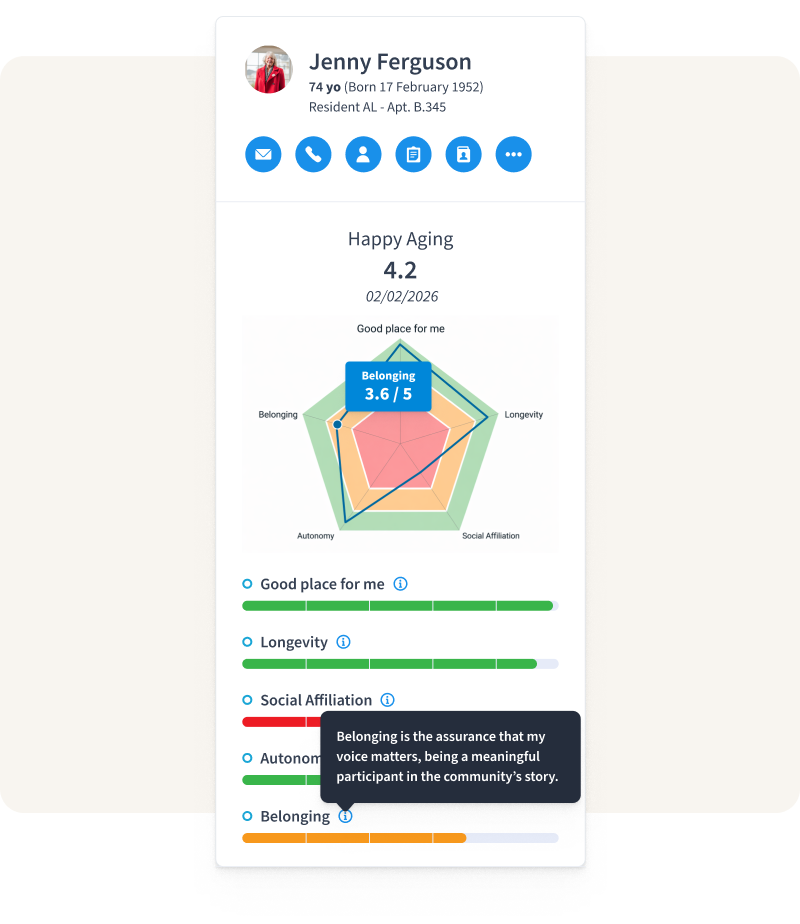
The instrument returns a personal and holistic Happy Aging 360, built around the 5 key domains of well-being that influence their quality of life: Good place for me, Longevity, Social Affiliation, Autonomy and Belonging, which all resonate the resident's deeper feelings.
Combined with a personal conversation about goals and preferences, Happy Aging 360 becomes the starting point for meaningful action. Supported by Cubigo's ‘Next Best Action’ recommendations, team members can guide residents on a personalized journey and help them stay connected and live better.
Residents today are looking for more than ‘care’; they want purpose, autonomy, and meaningful connections. Happy Aging 360 supports them in living life on their terms, while enhancing their well-being and sense of belonging.
For teams, resident well-being becomes tangible and actionable. Happy Aging 360 insights help team members to better understand resident expectations and purpose. The organisation may benefit from happy residents with an extended lifespan impacting length of stay / occupancy levels.
Well-being doesn’t stop at the resident; it extends to their loved ones. Communities that prioritize Happy Aging actively involve families, inviting them to take part in community life. The result is a warm, connected environment where relationships between residents, families, and team members can truly thrive.
To truly understand resident well-being, you need more than intuition. You need the combination of ground truth and the right framework to measure what truly matters.
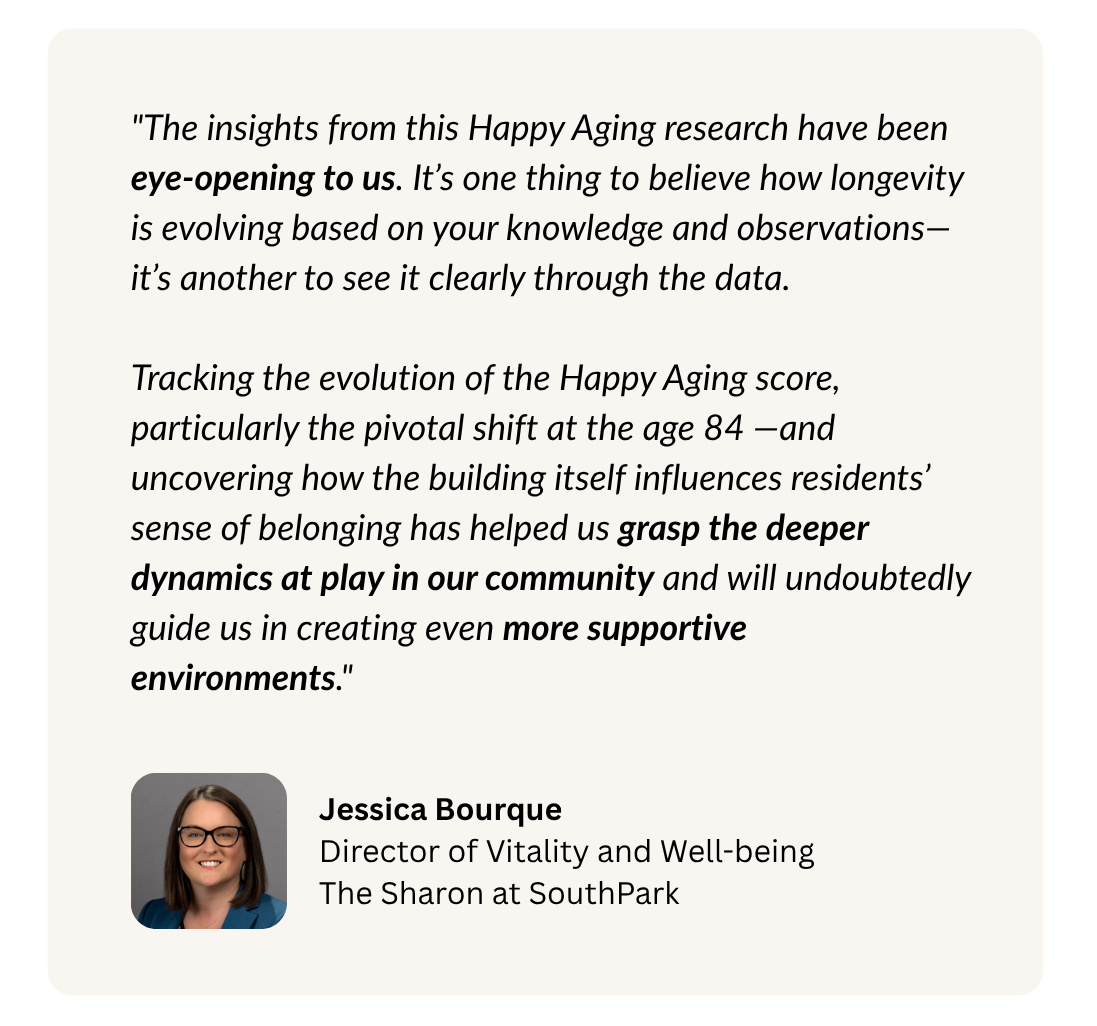
Happy Aging 360 is built with and for aging adults, combining scientific research with real-life context. It measures well-being across five key domains, based on 23 validated markers—the vital signs of well-being. This ensures every insight is grounded in what truly drives quality of life.

Happy Aging 360 is built on more than three years of in-depth scientific research and empirical evidence, supported by leading experts in gerontology and active aging from all over the world. It brings together scientific insights and real-world experience into one transformative and easy-to-implement solution.
Substantial research exists on loneliness, depression, and related dimensions of social well‑being. However, the empirical evidence base remains limited when these stand-alone constructs are examined specifically within the context of elderly care.
Happy Aging 360 takes a different approach. It was designed to reflect today’s reality, shaped by post-COVID challenges and the expectations of a new generation of residents. Most importantly, it has been validated within the context of senior living communities.
We didn’t just rely on existing theoretical models. We listened. In collaboration with several Life Plan Communities, we engaged more than 500+ residents through focus groups and workshops sharing what’s adding life to their years: social connections, autonomy, belonging, feeling at home and mental well-being.
These insights are the foundation of Happy Aging 360—a single, multi-dimensional instrument combining the 5 key domains of well-being and built on real experiences.
Well-being is personal. It evolves according to the context, experiences, and stage of life. That is why Happy Aging 360 is built on both research and real-world input.
We translated the empirical evidence collected from 500+ engaged residents living in Life Plan communities into a framework of more than 100 correlated critical determinants.
Together with leading gerontologists and researchers from VUB Belgian Ageing Studies (Belgium), these determinants were refined and validated into a clear, structured multi-dimensional model with five connected domains and 23 key markers, the vital signs of Happy Aging.
We conducted a broad, survey‑based longitudinal data collection, including a test–retest phase within the research population, using the 23‑marker model to evaluate stability and consistency. The results demonstrate the robustness of the Happy Aging 360 model and its strong internal reliability.
Integrated into the Cubigo app as a brief yet impactful assessment, residents complete a 3‑minute survey consisting of 23 clear statements with a consistent Likert-scale answer option (between strongly disagree to strongly agree). The instrument identifies who is aging happily and who may be experiencing lower‑than‑expected well‑being. The detailed domain‑level insights equip team members with a deeper understanding of underlying challenges and support the implementation of targeted, personalized intervention strategies.
We conducted a Principal Component Analysis as an exploratory factor analysis method. This resulted in a multi-dimensional model that represents resident well-being across five distinct domains (C1–C5), defined as latent variables. These domains are: Good place for me, Longevity, Social affiliation, Autonomy, and Belonging.
Using Structural Equation Modelling, these five closely related domains are defined by 23 observed indicators, deducted from the initial set of 100 determinants. These indicators are referred to as the 23 vital markers. Each of the five domains shows strong factor loadings, ranging from 0.73 to 0.90, confirming their relevance to resident well-being. The 23 markers also show strong relationships with the domains, with factor loadings between 0.70 and 0.90.
Based on Confirmatory Factor Analysis, we tested how well the model fits the observed data. With an explained variance of 75.5%, the Happy Aging 360 model captures a large part of what drives resident well-being. In other words, the 23 vital markers explain 75.5% of the variation in overall well-being.
With a Comparative Fit Index of 0.935 and a Cronbach alpha of 0.9, the model shows strong fit and high internal consistency. This confirms the robustness of Happy Aging 360 compared to other more ‘stand-alone’ social health instruments.
There is power in connection. Across all ages and regions, social isolation and loneliness remain widespread. Among older adults, 11.8% experience loneliness, making it a significant but often under-recognized factor in overall health. The impact goes beyond emotional well-being. People who lack strong social connections face a 30% higher risk of early death. This makes connection a fundamental pillar of healthy aging.
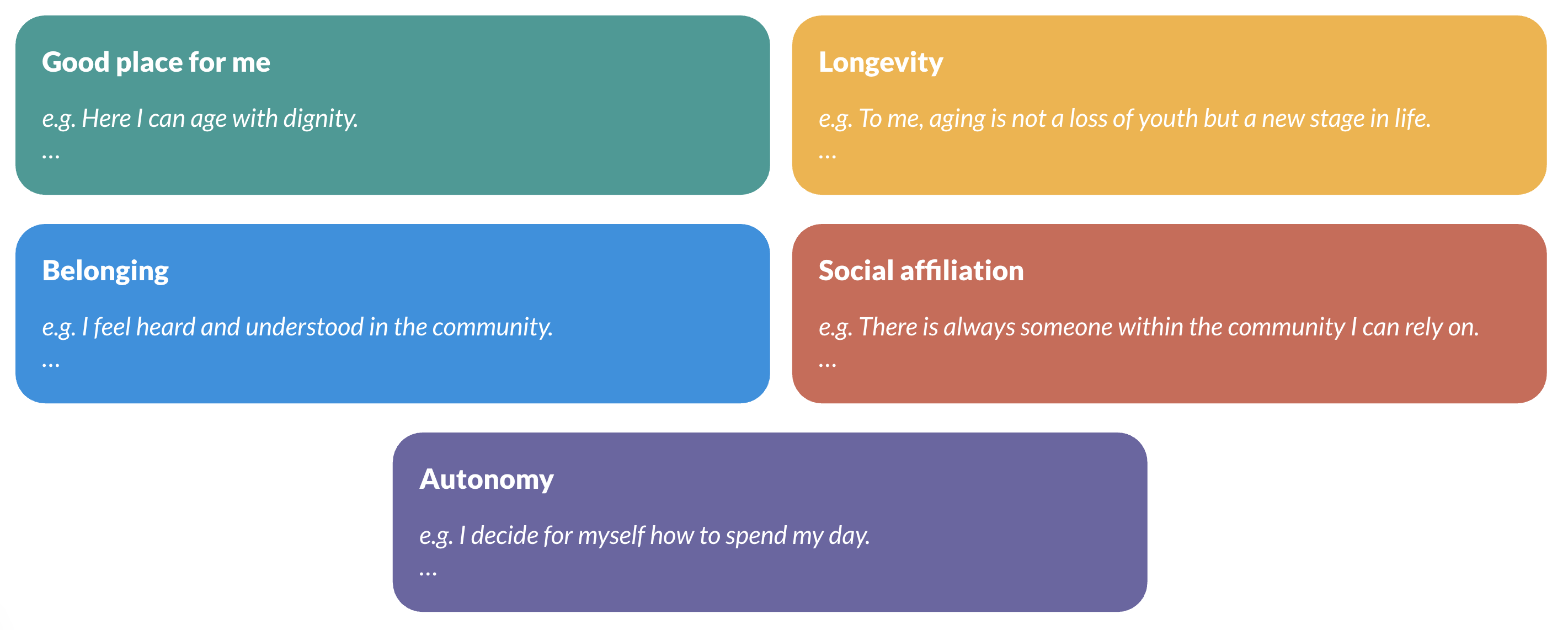
A holistic view on aging. At the same time, research shows that well-being is never defined by one factor alone. The Okinawa Centenarian Study, one of the world’s best-known Blue Zone studies, highlights the holistic perspective. Longevity and quality of life are shaped by a combination of physical activity, balanced nutrition, a supportive social network (moai), a sense of belonging, and a clear purpose in daily life (ikigai); it requires a holistic approach.
Catalyst to implementation. Happy Aging 360 is more than an assessment tool—it is a catalyst for a new way of managing resident well-being. By combining scientific rigor with real-world context and the power of an integrated platform, it enables communities to move from intuition to insight, and from reactive care to proactive well-being. Starting with a simple conversation and evolving into a fully connected, data-driven understanding of each resident, it empowers teams to create environments where people don’t just live longer, but live better. Because in the end, Happy Aging isn’t a concept—it’s a continuous, personalized journey, supported by the right insights at the right time.
Reach out to us at happyaging@cubigo.com to share your feedback, continue the conversation, or learn more about Happy Aging 360.